
Translucence Biosystems participated in the Society for Neuroscience annual meeting, held November 15–19, 2025, in San Diego, California. The team hosted booth #3224, where they connected with the neuroscience community and discussed how tissue clearing can help accelerate neuroscience research. The team also presented five posters showcasing advancements in high-resolution whole-brain clearing, imaging, and analysis. Together, these posters highlighted tools and techniques that address the limitations of traditional histology, including tissue clearing, light sheet imaging, AI-powered 3D quantification, and cloud-based platforms that enable comprehensive whole-brain and organ-level insights at scale. See an outline of the posters presented below!
Posters Presented
Easy-to-use tools for cleared tissue light sheet image analysis
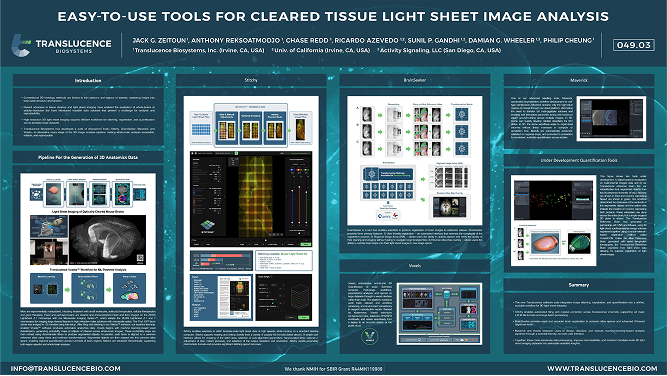
The poster presents a suite of analysis tools designed to make whole-brain AI-powered quantification accessible to all neuroscientists. Tissue clearing enables researchers to image intact brains at cellular resolution; however, it generates terabytes of data per experiment, which presents challenges for researchers.
To solve this, Translucence Biosystems developed Stitchy, Brainseeker, Maverick, and Voxels to streamline the workflow from image stitching and brain registration to machine learning-based quantification, enabling scientists to transform large 3D datasets into reproducible insights.
Brain-wide quantification of amyloid plaques, microglia, and disease-modifying antibodies in AD model mice
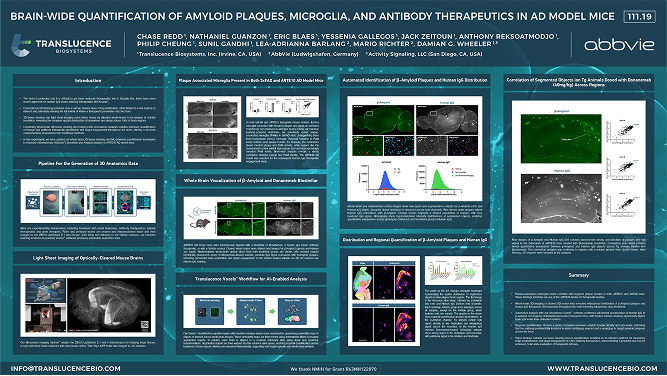
This poster addresses the need for new approaches to assess the brain biodistribution and target engagement of antibody therapeutics in intact tissue samples. By leveraging tissue clearing, light sheet microscopy, and machine learning-enabled analysis, our pipeline enables brain-wide, high-resolution imaging and quantification of intact tissue. The study successfully quantified β-Amyloid plaques, plaque-associated microglia, and human IgG-based therapeutics in whole mouse brains, revealing strong regional correlations between microglial density and local plaque burden. This demonstrates the efficacy of our pipeline for assessing therapeutic distribution and disease-related phenotypes, providing a fast, unbiased, and anatomically comprehensive method for evaluating antibody therapeutic penetration and efficacy in preclinical development of Alzheimer’s disease and other CNS-disease targeted therapeutics.
Simple Tools for Neuroscientists to Produce Brain-Wide Cellular Resolution Snapshots of Neuronal Activity Using Npas4 and cFos
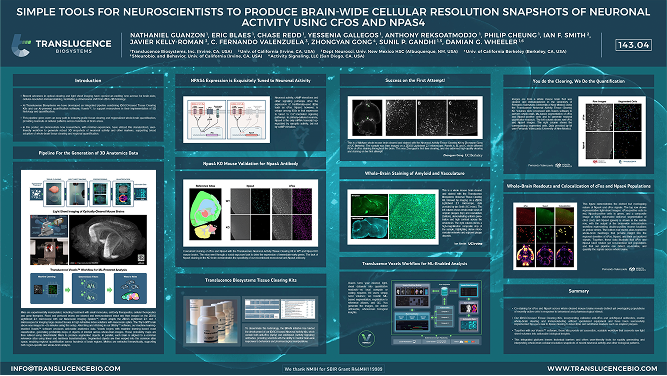
This poster highlights user-friendly tools for mapping neuronal activity across the whole brain. Our work compared two immediate-early gene markers, cFos and Npas4, showing that they respond differently to behavioral and pharmacological stimuli and label distinct yet overlapping neuronal populations. Supported by BRAIN Initiative funding, Translucence Biosystems developed iDISCO-based Neuronal Activity Kits to help neuroscientists bring this assay to their own lab. The kits include validated antibodies, and when analyzed with our cloud-based Voxels software, even researchers with minimal tissue clearing experience are able to generate brain-wide regional outputs of recently active neurons.
Brain-wide quantification of a BBB-crossing antibody therapeutic targeting amyloid plaques
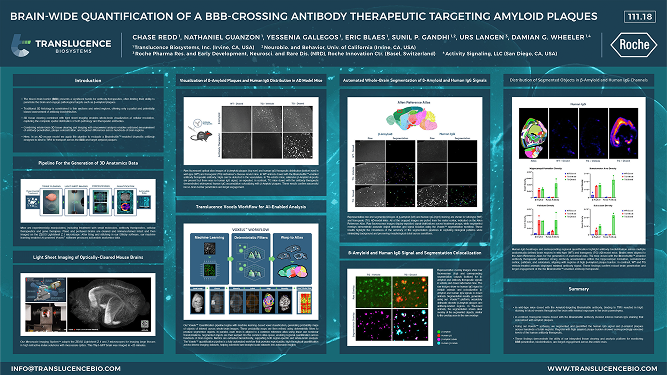
In this poster, we demonstrate an integrated pipeline for evaluating BBB-crossing antibody therapeutics in the brain. Using tissue clearing, light sheet microscopy, and our Voxels software, we assessed a Brain shuttle-enabled antibody designed to cross the blood-brain barrier and target amyloid plaques in an Alzheimer's disease mouse model. Therapeutic antibody colocalized with amyloid plaques throughout the brain, with higher antibody levels in regions with greater plaque burden, demonstrating the platform's utility for monitoring drug distribution and target engagement.
High-throughput immunohistochemistry imaging and quantification using PMT-generated images and cloud-based AI-powered software
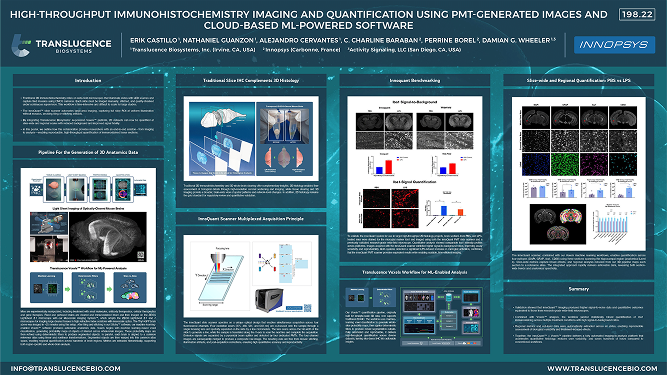
In collaboration with Innopsys, Translucence Biosystems extended our Voxels machine-learning platform to work with traditional 2D histology datasets, enabling the rapid processing of large numbers of slides with high accuracy. This was validated through a collaborative study where brain sections from mice were stained for the microglial marker Iba1 and imaged using both the InnoQuant scanner and a research-grade wide-field scope, demonstrating nearly identical intensity profiles and quantitative read-outs across platforms. Building on this validation, we performed a 24-slide experiment, capturing whole-brain slice images in four fluorescent channels (DAPI, GFAP, Iba1 and CD68) and generated cellular resolution count and intensity data on each channel as well as colocalization metrics. The combined InnoQuant and Voxels pipeline delivers rapid and reproducible quantitative IHC data, helping accelerate R&D and early drug discovery timelines.
Thank you to attendees who joined us at the Society for Neuroscience (SfN) Annual Meeting in San Diego. We look forward to supporting your research and connecting at next year's annual meeting. If you spoke with one of our team members at the meeting, and you would like to continue the conversation, please reach out to info@translucencebio.com!
Download materials
Download materials
To access materials from this article, please complete the corresponding form
Ask your question
Send us your questions and we will get back to you as soon as possible
info@translucencebio.com
